Business owners rarely think of control as micromanagement. They think of it as visibility and visibility can be interpreted in many ways, but at its core, it depends on timely, accurate sales data , the kind that shows how a business is performing day by day, not weeks later. In growing businesses, especially those operating across multiple locations, channels, or payment methods, the absence of this clarity introduces risk.
Payments are Not a Back-Office Function, they are the Business Engine
Every business, regardless of the sector, runs on payments. They determine how quickly cash moves through the organization, how confidently suppliers are paid, and how effectively the business can reinvest in growth.
When payments are delayed, unclear, or fragmented across systems, the impact extends far beyond accounting. Cash flow becomes unpredictable, limiting flexibility. Customer experience suffers, often invisibly at first. Trust erodes both internally and externally.
For business owners, this creates an uncomfortable reality: decisions are being made with partial information. Clear daily sales reports address this directly by turning payment activity into structured, usable insight.
The Strategic Cost of Poor Sales Visibility
Many businesses believe they have visibility simply because transactions are being processed. In practice, transaction processing and transaction insight are not the same thing.
When daily sales visibility is weak, certain indicators tend to surface quietly at first. End-of-day figures fail to align with bank settlements. Underperforming outlets or teams are identified late, often after trends have already set in. Reporting varies from branch to branch or channel to channel, making comparisons unreliable. Cash flow management becomes more reactive than planned.
What begins as minor reconciliation gaps turns into systemic uncertainty. Business owners' time shifts away from strategy and execution and toward questioning numbers, validating reports, and resolving discrepancies that should never have reached the executive level.
What Business owners Need from Daily Sales Reports
For business owners, daily sales reports are not about operational details. They are about answers.
At a glance, business owners need to understand how much revenue was generated today and how it compares historically, which payment methods are driving both volume and value, whether cash flow is tracking against expectations, and where risks or anomalies may be emerging.
This level of clarity allows leadership to focus on direction and execution rather than verification.
Why POS-Driven Reporting Changes the Equation
Point-of-sale systems sit at the intersection of payments, operations, and data. When designed well, they consolidate transactions across in-store, mobile, and card payments into a single source of truth.
For business owners and leadership teams, this delivers clear strategic advantages: unified visibility across the business, consistent reporting standards across locations, and faster access to performance insights that can actually be acted on.
As businesses adopt more complex, omnichannel models, this consolidation becomes essential rather than optional.
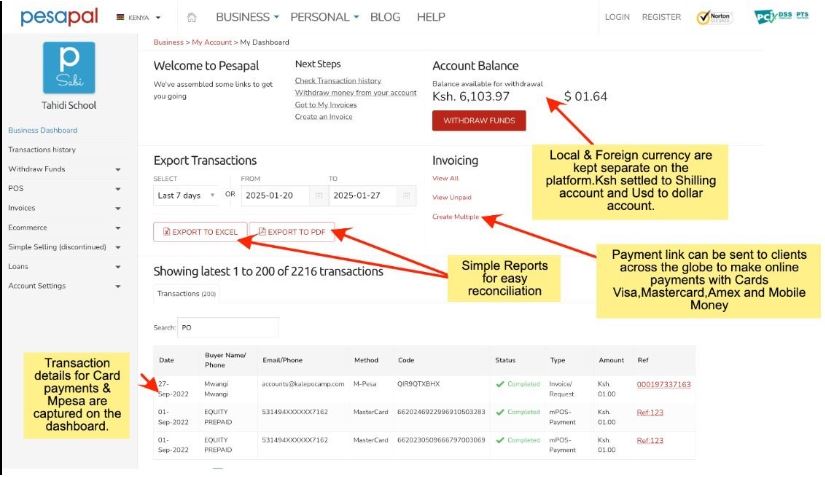
*Pesapal Daily Transaction Data Dashboard
Turning Data into Actionable Insight
Data alone does not drive value. Insights do. Daily sales reports become powerful when they highlight patterns rather than just totals. Over time, business owners can identify seasonal and daily demand trends, shifts in payment behavior, and performance differences between outlets or teams.
These insights inform decisions around pricing, staffing, promotions, and expansion. More importantly, they allow business owners to act early before small issues escalate into material risks.
Read more: Do More: How the Pesapal Dashboard Powers Smart Business Decisions
The Business Owners Lens: Why Daily Reporting Changes Leadership Outcomes
For business owners, the difference between operational awareness and strategic control often comes down to timing.
Monthly and even weekly reports are lagging indicators. By the time they surface, problems like cash flow gaps, declining customer experience, or performance bottlenecks have already been felt. Daily sales reports function differently. They act as early-warning systems.
For business owners, this means spotting risk before it becomes material. For finance leaders, it means identifying reconciliation issues or settlement delays before they distort forecasts. For operations heads, it allows rapid course correction at the outlet or team level.
Over time, daily visibility changes leadership behavior. Decisions move from reactive to deliberate. Conversations shift from “what happened?” to “why is this happening now, and what do we do next?”
As businesses grow, complexity often increases faster than headcount or systems maturity. Business owners who rely on delayed reporting tend to compensate by adding controls, approvals, or manual checks, slowing the business down in the process. Clear daily sales reporting removes the need for that friction. It enables oversight without micromanagement.
Daily Visibility in a Digital Payments Economy
As businesses move further into digital and mobile payments, complexity increases. Multiple wallets, cards, QR codes, and online channels introduce operational and reporting challenges.
Without a consolidated view, leadership risks incomplete performance analysis, higher exposure to fraud or error, and missed opportunities to optimize the payment mix.
Daily sales reporting, anchored in modern POS infrastructure, provides the structure needed to manage this complexity without slowing the business down.
Over and above, in an increasingly digital payments economy, control does not come from tighter oversight. It comes from better visibility.
Clear daily sales reports transform payments from a transactional necessity into a strategic asset. They support cash flow resilience, enhance customer experience, strengthen trust, and enable smart leadership decisions.
For businesses serious about sustainable growth, daily sales visibility is no longer optional. It is a leadership requirement.